
Program Overview
Vehicle crashes account for more than 32,000 deaths each year and are the leading cause of death for Americans between the ages of 4 and 35 years, according to the Centers for Disease Control. In the past, the U.S. DOT has focused on helping people survive crashes. Connected vehicle safety will change the paradigm by helping people avoid crashes.
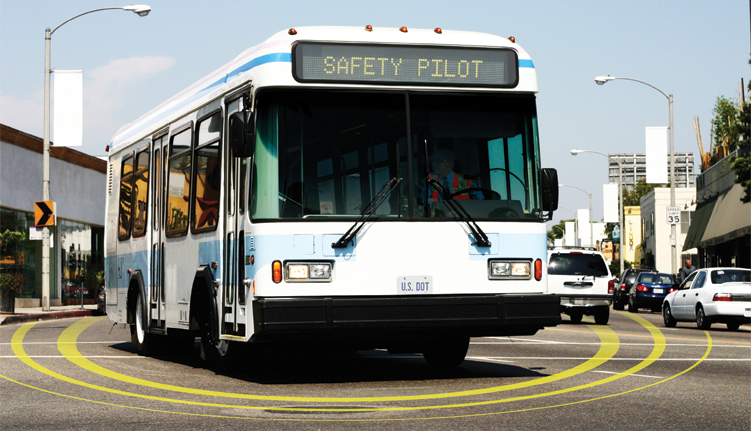
Connected Vehicles
The use of dedicated, short-range wireless communications (DSRC) in the transportation environment combined with advanced vehicle-to-vehicle (V2V) and vehicle-to-infrastructure (V2I) safety applications offers some of the most promising, near-term opportunities for crash reductions. This combination of innovative technologies enables communications among vehicles and between vehicles and the infrastructure (which may include traffic signals, work zone equipment, or pavement sensors, among other infrastructure elements). To find out more about the potential of connected vehicles, view a video about connected vehicle technologies or access additional connected vehicle resources at the Intelligent Transportation Systems (ITS) Joint Program Office (JPO) website.
National Highway Traffic Safety Administration (NHTSA) research found that connected vehicle systems have the potential to address more than 80% of unimpaired driver crash scenarios. However, more research is needed to understand the true effectiveness of this technology. To do so, the USDOT's ITS Program has defined a significant test and evaluation effort — the Connected Vehicle Safety Pilot.
Connected Vehicle Safety Pilot Program
The Connected Vehicle Safety Pilot Program is a scientific research initiative that features a real-world implementation of connected vehicle safety technologies, applications, and systems using everyday drivers. The effort will test performance, evaluate human factors and usability, observe policies and processes, and collect empirical data to present a more accurate, detailed understanding of the potential safety benefits of these technologies. This empirical data will be critical to supporting the 2013 NHTSA agency decision on vehicle communications for safety.
The vision for the Connected Vehicle Safety Pilot Program is to provide the world with a model deployment that demonstrates the transformative nature and benefits of connected vehicle technologies for safety and that can be further extended to support non-safety needs relating to mobility and environmental impacts. The Safety Pilot program includes two critical test initiatives—the Safety Pilot Driver Clinics and the Safety Pilot Model Deployment.
Safety Pilot Driver Clinics
In August 2011, the Safety Pilot Driver Clinics tested the new V2V safety applications with everyday drivers in controlled roadway environments such as test tracks. The evaluations explored driver reactions to safety applications using a variety of light-duty vehicles (cars) and under a variety of test conditions. Separate driver clinics were conducted for commercial trucks.
The clinics were conducted at six sites geographically dispersed throughout the United States. Approximately 100 drivers tested the technologies at each driver clinic. The driver clinics were an important first step in identifying how drivers respond to new innovative wireless devices for safety.
Safety Pilot Model Deployment
To continue the data collection under real-world conditions, a test site with multimodal traffic is hosting approximately 2,800 vehicles equipped with V2V devices. The goal is to create a highly concentrated connected vehicle communications environment with vehicles “talking to each other”.
The devices being tested emit a basic safety message (BSM) 10 times per second, which forms the basic data stream that other in-vehicle devices use to determine when a potential conflict exists. When this data is further combined with the vehicle’s own data, it creates a highly accurate data set that is the foundation for cooperative, crash avoidance safety applications. Using a mix of cars, trucks, and transit vehicles, the Safety Pilot Model Deployment will create test data sets for determining the technologies’ effectiveness at reducing crashes.
These capabilities also have been extended to a limited set of vehicle-to-infrastructure (V2I) applications. Additional benefits of connected vehicle technology can be realized from V2I interactions, primarily at signalized intersections equipped with DSRC. Such intersections will broadcast signal timing information to on-coming vehicles. As vehicles approach an intersection, drivers will be alerted to signal timing changes and potential conflicts with other vehicles. These applications will not only help reduce intersection crashes, but have the potential to reduce vehicle idling, stops, and resulting emissions.
The goals of the Safety Pilot Model Deployment are as follows:
- Demonstrate connected vehicle technologies in a real world, multi-modal environment
- Determine driver acceptance of vehicle-based safety systems
- Evaluate the feasibility, scalability, security and interoperability of Dedicated Short Range Communications technology
- Assess options to accelerate safety benefits